Black Soldier Fly and Your Waste Management
6 pages · Original document, with a text alternative under each page.
Read page 1 as text
3
Black Soldier Fly and Your Waste Management
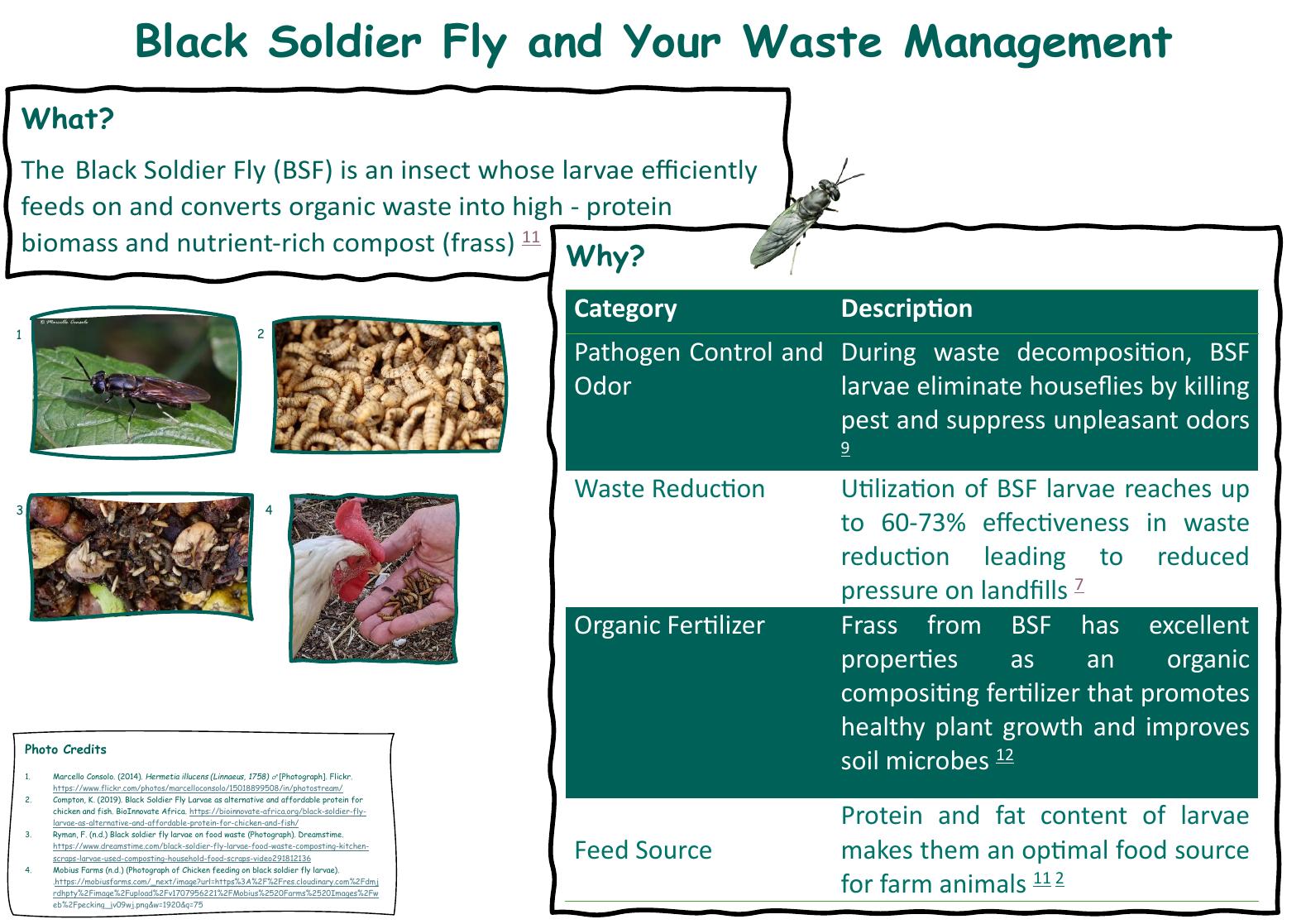
What?
The Black Soldier Fly (BSF) is an insect whose larvae efficiently
feeds on and converts organic waste into high - protein
biomass and nutrient-rich compost (frass) 11
Why?
Category Description
Pathogen Control and
Odor
During waste decomposition, BSF
larvae eliminate houseflies by killing
pest and suppress unpleasant odors
9
Waste Reduction Utilization of BSF larv ae reaches up
to 60-73% effectiveness in waste
reduction leading to reduced
pressure on landfills 7
Organic Fertilizer Frass from BSF has excellent
properties as an organic
compositing fertilizer that promotes
healthy plant growth and improv es
soil microbes 12
Feed Source
Protein and fat content of larvae
makes them an optimal food source
for farm animals 11 2
Photo Credits
1. Marcello Consolo. (2014). Hermetia illucens (Linnaeus, 1758) ♂ [Photograph]. Flickr.
https://www.flickr.com/photos/marcelloconsolo/15018899508/in/photostream/
2. Compton, K. (2019). Black Soldier Fly Larvae as alternative and affordable protein for
chicken and fish. BioInnovate Africa. https://bioinnovate-africa.org/black-soldier-fly-
larvae-as-alternative-and-affordable-protein-for-chicken-and-fish/
3. Ryman, F. (n.d.) Black soldier fly larvae on food waste (Photograph). Dreamstime.
https://www.dreamstime.com/black-soldier-fly-larvae-food-waste-composting-kitchen-
scraps-larvae-used-composting-household-food-scraps-video291812136
4. Mobius Farms (n.d.) (Photograph of Chicken feeding on black soldier fly larvae).
.https://mobiusfarms.com/_next/image?url=https%3A%2F%2Fres.cloudinary.com%2Fdmj
rdhpty%2Fimage%2Fupload%2Fv1707956221%2FMobius%2520Farms%2520Images%2Fw
eb%2Fpecking_jv09wj.png&w=1920&q=75
1 2
4
Read page 2 as text
7
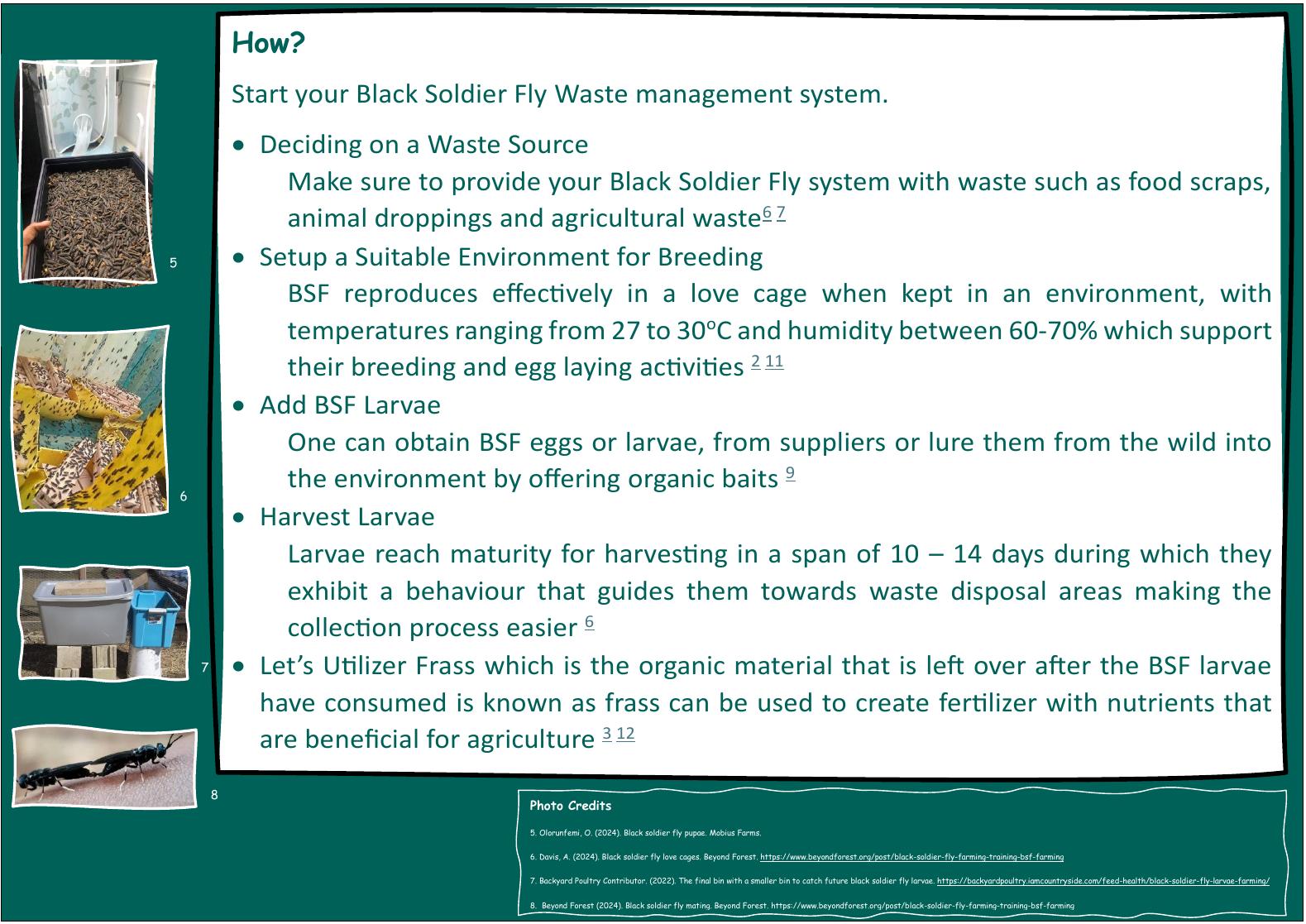
How?
Start your Black Soldier Fly Waste management system.
• Deciding on a Waste Source
Make sure to provide your Black Soldier Fly system with waste such as food scraps,
animal droppings and agricultural waste 6 7
• Setup a Suitable Environment for Breeding
BSF reproduce s effectively in a love cage when kept in an environment, with
temperatures ranging from 27 to 30oC and humidity between 60-70% which support
their breeding and egg laying activities 2 11
• Add BSF Larvae
One can obtain BSF eggs or larvae, fr om suppliers or lure them from the wild into
the environment by offering organic baits 9
• Harvest Larvae
Larvae reach maturity for harvesting in a span of 10 – 14 days during which they
exhibit a behaviour that guides them towards waste disposal areas making the
collection process easier 6
• Let’s Utilizer Frass which is t he organic materi al that is left over after the BSF larvae
have consumed is known as frass can be used to create fertilizer with nutrients that
are beneficial for agriculture 3 12
Photo Credits
5. Olorunfemi, O. (2024). Black soldier fly pupae. Mobius Farms.
6. Davis, A. (2024). Black soldier fly love cages. Beyond Forest. https://www.beyondforest.org/post/black-soldier-fly-farming-training-bsf-farming
7. Backyard Poultry Contributor. (2022). The final bin with a smaller bin to catch future black soldier fly larvae. https://backyardpoultry.iamcountryside.com/feed-health/black-soldier-fly-larvae-farming/
8. Beyond Forest (2024). Black soldier fly mating. Beyond Forest. https://www.beyondforest.org/post/black-soldier-fly-farming-training-bsf-farming
5
6
8
Read page 3 as text
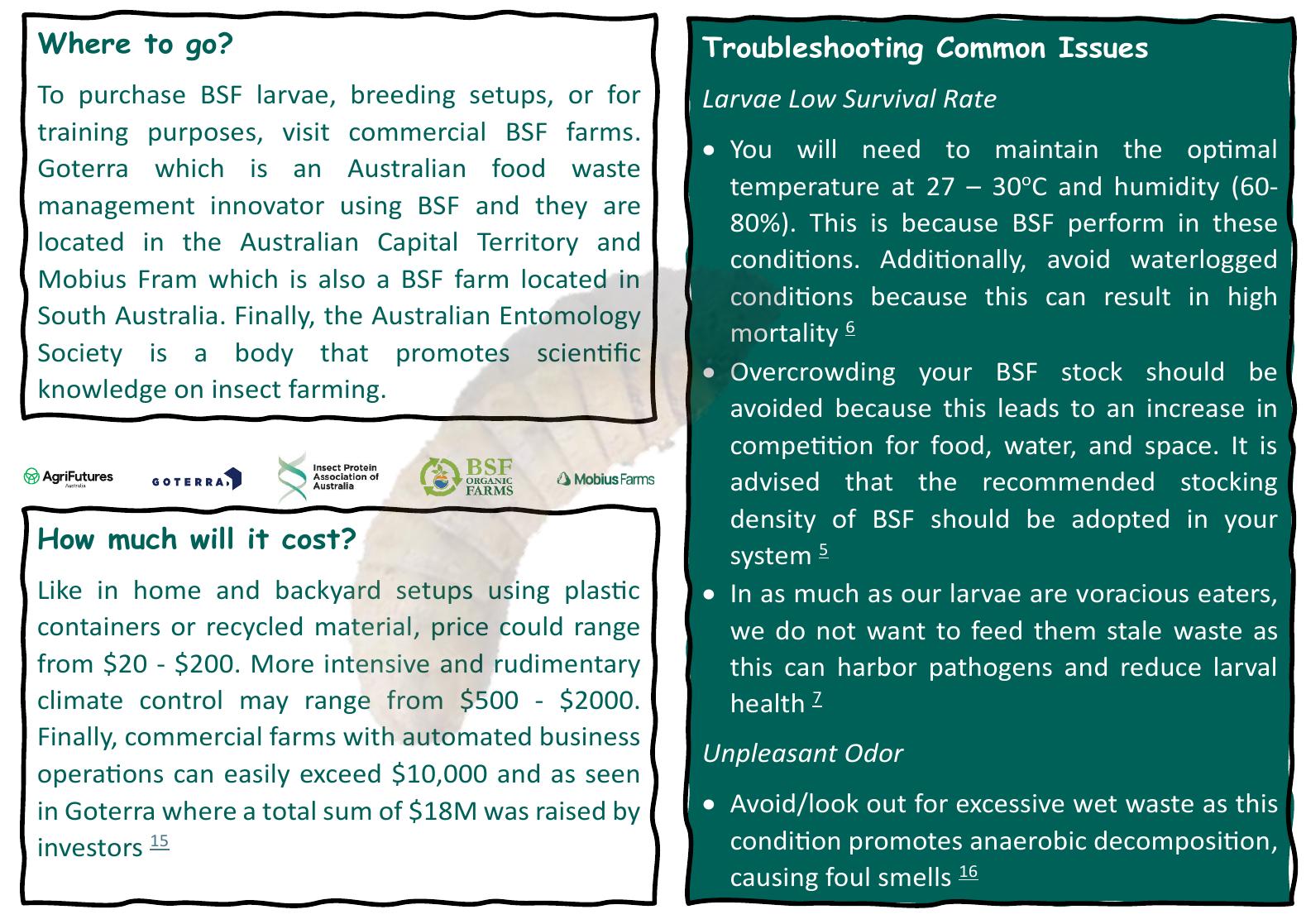
Where to go?
To purchase BSF larv ae, breeding setups, or for
training purpose s, visit commercial BSF farms .
Goterra which is an Australian food waste
management innovator using BSF and they are
located in the Australian Capital Territory and
Mobius Fram which is also a BSF farm located in
South Australia. Finally, the Australian Entomology
Society is a body that promotes scientific
knowledge on insect farming.
How much will it cost?
Like in home and backyard setups using plastic
containers or recycled material , price could range
from $20 - $200. More intensive and rudimentary
climate control may range from $500 - $2000.
Finally, commercial farms with automated business
operations can easily exceed $10,000 and as seen
in Goterra where a total sum of $18M was raised by
investors 15
Troubleshooting Common Issues
Larvae Low Survival Rate
• You will need to maintain the optimal
temperature at 27 – 30oC and humidity (60-
80%). This is be cause BSF perform in these
conditions. Additionally, avoid waterlogged
conditions because this can result in high
mortality 6
• Overcrowding your BSF stock should be
avoided because th is leads to an increase in
competition for food, water, and space. It is
advised that the recommended stocking
density of BSF should be adopted in your
system 5
• In as much as our larvae are v oracious eaters,
we do not want to feed them stale waste as
this can harbor pathogens and reduce larval
health 7
Unpleasant Odor
• Avoid/look out for excessive wet waste as this
condition promotes anaerobic decomposition,
causing foul smells 16
Read page 4 as text
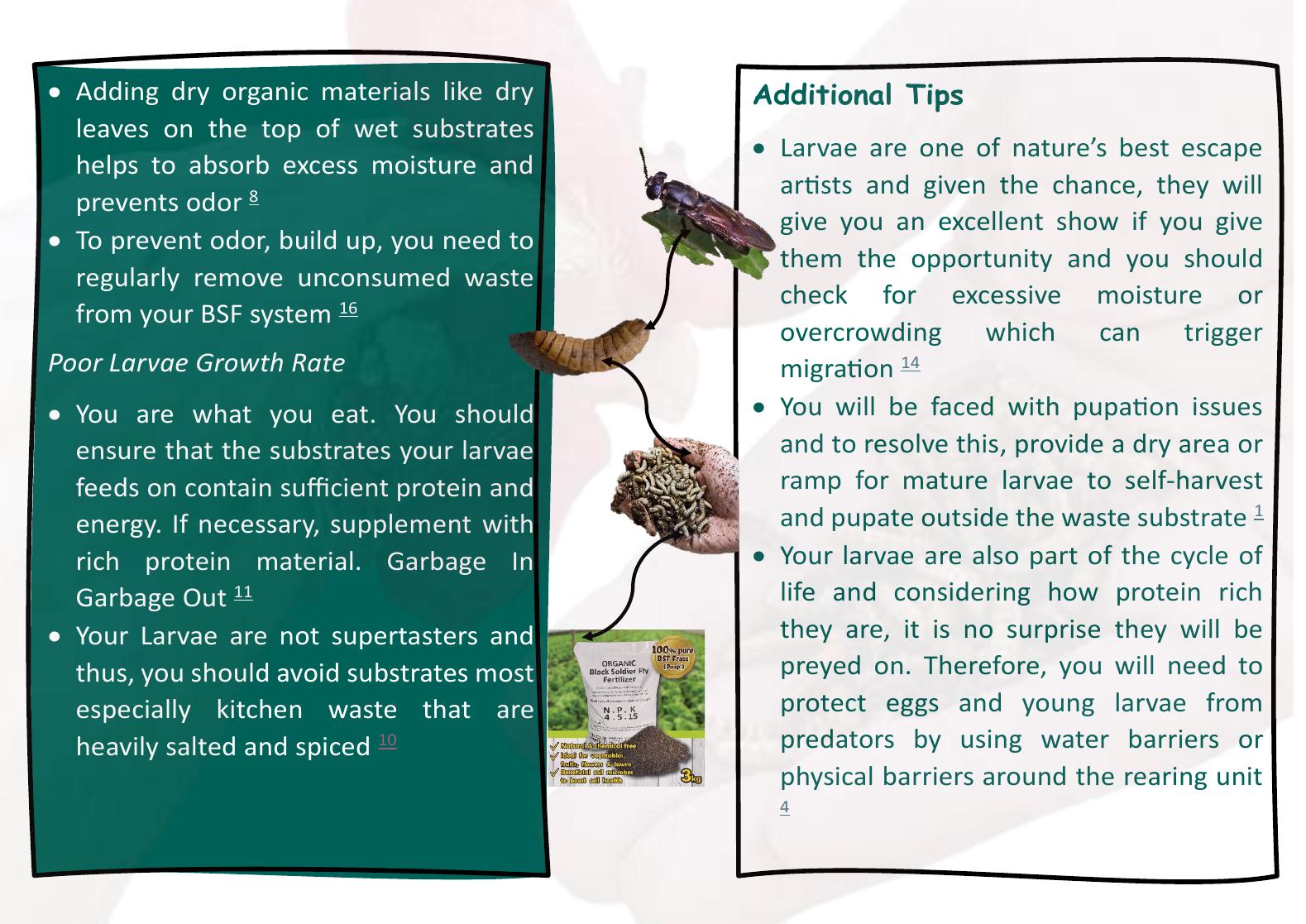
• Adding dry organic materials like dry
leaves on the top of wet substrates
helps to absorb excess moisture and
prevents odor 8
• To prevent odor, build up, you need to
regularly remove unconsumed waste
from your BSF system 16
Poor Larvae Growth Rate
• You are what you eat . You should
ensure that the substrates your larvae
feeds on contain sufficient protein and
energy. If necessary, supplement with
rich protein material. Garbage In
Garbage Out 11
• Your Larvae are not supertas ters and
thus, you should avoid substrates most
especially kitchen waste that are
heavily salted and spiced 10
Additional Tips
• Larvae are one of nature’s best escape
artists and given the chance, they will
give you a n excellent show if you give
them the opportunity and you should
check for excessive moisture or
overcrowding which can trigger
migration 14
• You will be faced with pupation issues
and to resolve this, provide a dry area or
ramp for mature larvae to self -harvest
and pupate outside the waste substrate 1
• Your larvae are also part of the cycle of
life and considering how protein rich
they are, it is no surprise they will be
preyed on. Therefore, y ou will need to
protect eggs and young larvae from
predators by using water barriers or
physical barriers around the rearing unit
4
Read page 5 as text
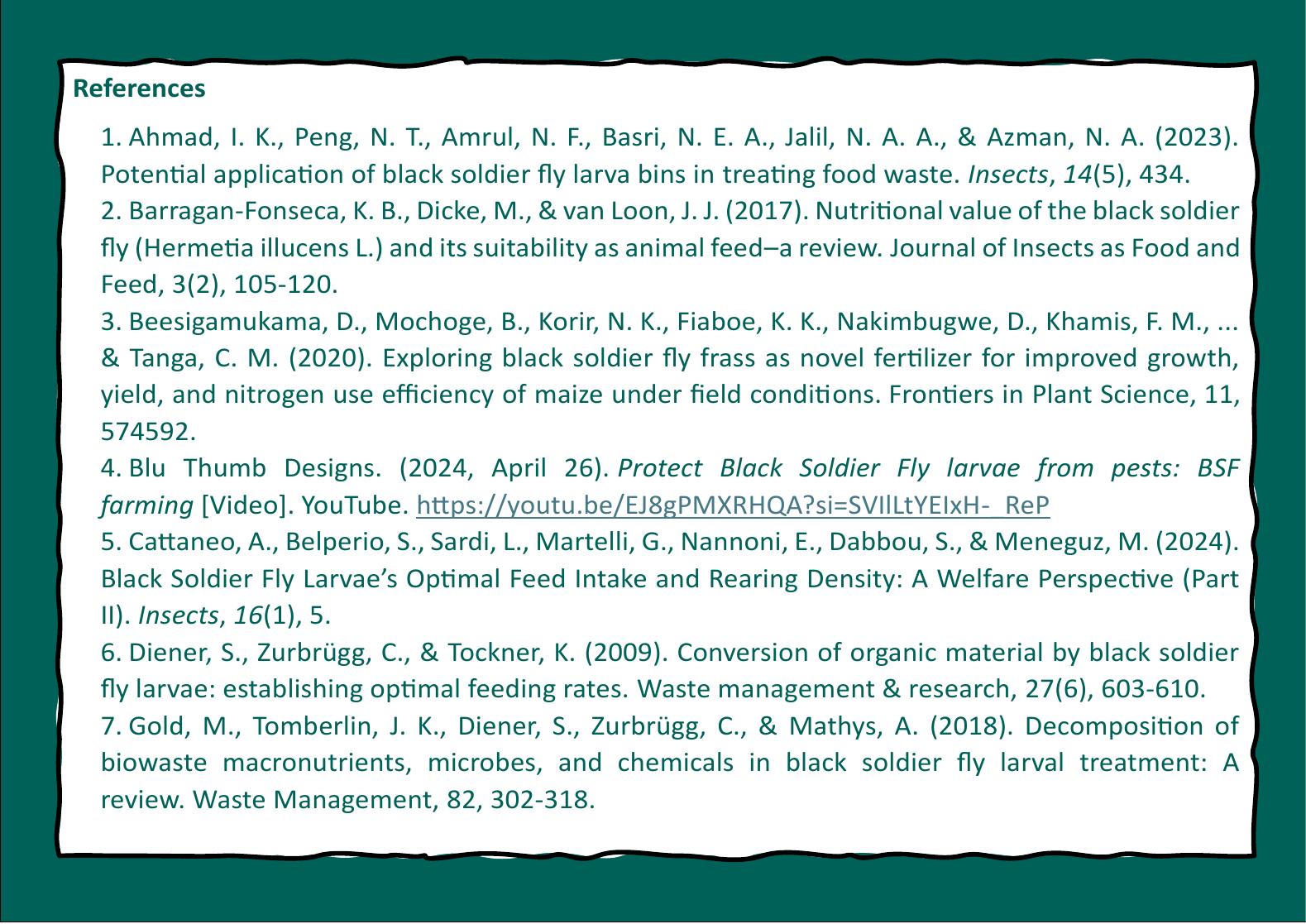
References
1. Ahmad, I. K., Peng, N. T., Amrul, N. F., Basri, N. E. A., Jalil, N. A. A., & Azman, N. A. (2023).
Potential application of black soldier fly larva bins in treating food waste. Insects, 14(5), 434.
2. Barragan-Fonseca, K. B., Dicke, M., & van Loon, J. J. (2017). Nutritional value of the black soldier
fly (Hermetia illucens L.) and its suitability as animal feed–a review. Journal of Insects as Food and
Feed, 3(2), 105-120.
3. Beesigamukama, D., Mochoge, B., Korir, N. K., Fiaboe, K. K., Nakimbugwe, D., Khamis, F. M., ...
& Tanga, C. M. (2020). Exploring black soldier fly frass as novel fertilizer for improved growth,
yield, and nitrogen use efficiency of maize under field conditi ons. Frontiers in Plant Science, 11,
574592.
4. Blu Thumb Designs. (2024, April 26). Protect Black Soldier Fly larvae from pests: BSF
farming [Video]. YouTube. https://youtu.be/EJ8gPMXRHQA?si=SVIlLtYEIxH-_ReP
5. Cattaneo, A., Belperio, S., Sardi, L., Martelli, G., Nannoni, E., Dabbou, S., & Meneguz, M. (2024).
Black Soldier Fly Larvae’s Optimal Feed Intake and Rearing Density: A Welfare Perspective (Part
II). Insects, 16(1), 5.
6. Diener, S., Zurbrügg, C., & Tockner, K. (2009). Conversion of organic material by black soldier
fly larvae: establishing optimal feeding rates. Waste management & research, 27(6), 603-610.
7. Gold, M., Tomberlin, J. K., Diener, S., Zurbrügg, C., & Mathys, A. (2018). Decomposition of
biowaste macronutrients, microbes, and chemicals in black soldier fly larval treatment: A
review. Waste Management, 82, 302-318.
Read page 6 as text
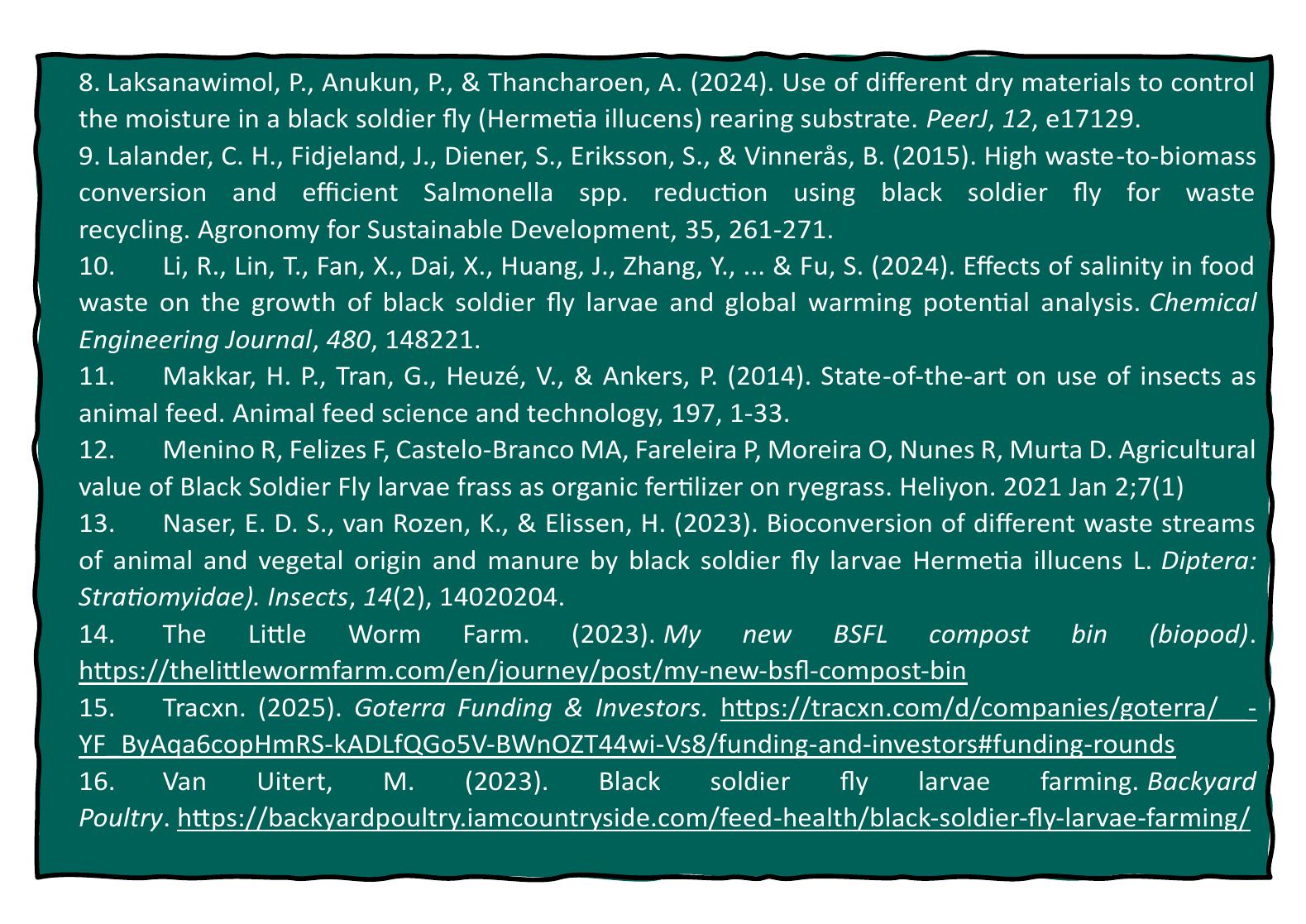
8. Laksanawimol, P ., Anukun, P ., & Thancharoen, A. (2024). Use of different dry materials to control
the moisture in a black soldier fly (Hermetia illucens) rearing substrate. PeerJ, 12, e17129.
9. Lalander, C. H., Fidjeland, J., Diener, S., Eriksson, S., & Vinnerås, B. (2015). High waste -to-biomass
conversion and efficient Salmonella spp. reduction using black soldier fly for waste
recycling. Agronomy for Sustainable Development, 35, 261-271.
10. Li, R., Lin, T., Fan, X., Dai, X., Huang, J., Zhang, Y ., ... & Fu, S. (2024). Effects of salinity in food
waste on the growth of black soldier fly larvae and global warming potential analysis. Chemical
Engineering Journal, 480, 148221.
11. Makkar, H. P ., Tran, G., Heuzé, V., & Ankers, P . (2014). State-of-the-art on use of insects as
animal feed. Animal feed science and technology, 197, 1-33.
12. Menino R, Felizes F, Castelo-Branco MA, Fareleira P , Moreira O, Nunes R, Murta D. Agricultural
value of Black Soldier Fly larvae frass as organic fertilizer on ryegrass. Heliyon. 2021 Jan 2;7(1)
13. Naser, E. D. S., van Rozen, K., & Elissen, H. (2023). Bioconversion of different waste streams
of animal and vegetal origin and manure by black soldier fly larvae Hermetia illucens L. Diptera:
Stratiomyidae). Insects, 14(2), 14020204.
14. The Little Worm Farm. (2023). My new BSFL compost bin (biopod) .
https://thelittlewormfarm.com/en/journey/post/my-new-bsfl-compost-bin
15. Tracxn. (2025). Goterra Funding & Investors . https://tracxn.com/d/companies/goterra/__-
YF_ByAqa6copHmRS-kADLfQGo5V-BWnOZT44wi-Vs8/funding-and-investors#funding-rounds
16. Van Uitert, M. (2023). Black soldier fly larvae farming. Backyard
Poultry. https://backyardpoultry.iamcountryside.com/feed-health/black-soldier-fly-larvae-farming/